
Professional Ski Boot Fitting in Banff
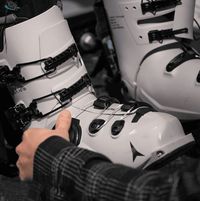
Better Ski Days Start With Better-Fitting Boots
Your boots are where every movement you make gets transferred to your skis. If they’re too loose, too tight, or simply the wrong shape for your feet, you’ll probably notice right away!
That’s why a proper boot fit involves a lot more than asking for your regular shoe size. Our trained bootfitters look at the length, width, volume, and biomechanics of your feet to narrow down boots that suit both your anatomy and the way you ski.
Once we have a better picture of your feet, it’s time to try on some boots. We’ll help you compare the fit and find that sweet spot between comfortably snug and properly supportive, without unnecessary pressure points. Your heel should stay secure when you flex forward, giving you a solid connection to the boot and better control over your skis.
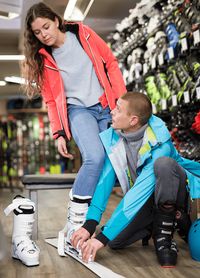
What We Look at During Your Boot Fit
During your fitting, we evaluate several key factors:
• Length – Ski boots use the Mondo Point sizing system rather than traditional shoe sizing. Unlike shoes, which allow your foot to move naturally while walking, ski boots are designed to keep your foot secure and stable for maximum control.
• Width (Last) – Most ski boots are built around three common last widths: 98mm, 100mm, and 102mm, representing narrow, medium, and wide fits. Measuring your foot width helps us determine which boots will provide the best fit.
• Volume – Foot volume refers to the amount of space your arch and instep occupy inside the boot. Understanding this helps us identify which boot shapes and models will work best for your foot.
• Biomechanics – Your biomechanics play a major role in boot selection. We assess factors such as arch flex, dorsiflexion, foot tension, ankle mobility, and heel alignment. These evaluations can also indicate whether custom footbeds would improve your stability and alignment.
Book A Boot Adjustment
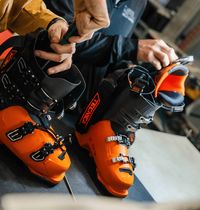
Boots not fitting quite right? Getting pressure points, heel lift, or shin bang?
Come see one of our trained bootfitters for an assessment. We’ll work with you to dial in your boots and make them as comfortable as a ski boot can be.
Depending on your boots and fit, adjustments may include:
• Heat moulding compatible liners or shells
• Shell punching or stretching
• Grinding problem areas
• Liner modifications
• Heel and volume adjustments
• Custom footbeds
• Forward lean adjustments
• Cuff alignment
Boot Alignment for Better Balance and Control
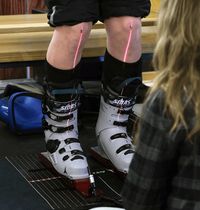
Sometimes the problem isn’t simply how your foot fits inside the boot. It’s how your boots work with your natural stance.
Our team at Bear Street Outfitters has extensive experience with ski boot alignment, from cuff alignment to under-sole canting. Cuff alignment adjusts the upper portion of the boot to match your lower-leg angle better, while sole canting changes how the boot interfaces with the binding. Done properly, these adjustments can improve alignment, balance, edge engagement, and overall control on your skis.
If you feel like you’re constantly fighting to get onto an edge, struggle to stand neutrally in your boots, or want to fine-tune a performance setup, give us a call. We’ll assess your stance and see whether alignment work could help.


Hear What Our Clients Have To Say